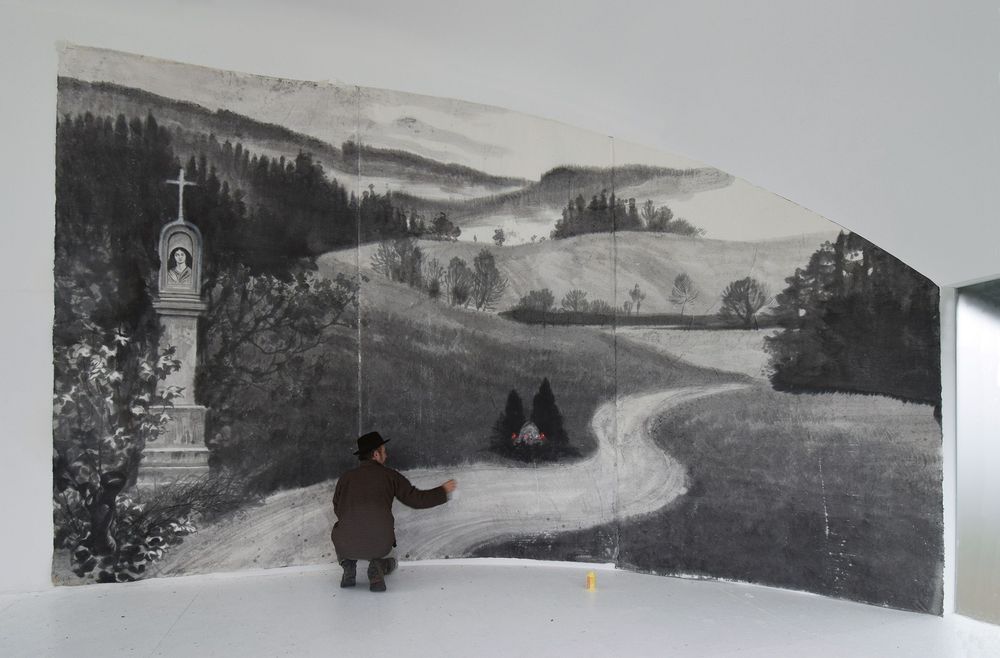
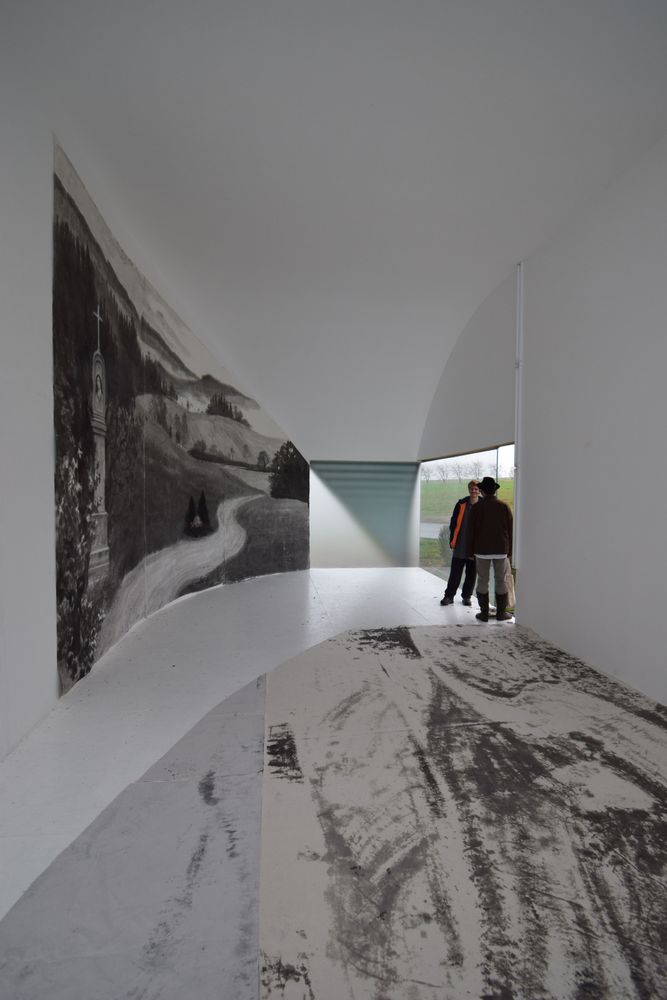
The All Souls' Day
Jiří Straka
Tush painting by Jiří Straka
Jiří Straka studied Sinology at Charles University in Prague and is a connoisseur and admirer of ancient Chinese culture. He wears traditional Chinese clothing all year round and looks more Chinese than most Chinese people. In the mid-1990s, Jiří Straka came to Beijing to study ink painting at the Central Academy of Fine Arts. He has a mastery of its traditional processes and techniques, but does not let himself be bound by rigid adherence to its rules. He has arrived at mature ink paintings that, according to traditional terminology, would fall into the category of so-called boneless painting. From a formal point of view, he has moved away from the mainstream of Chinese literati free brush painting, daxieyi. He often paints a particular landscape or flowers and plants directly in the plein air, spreads out the paper, kneels down and begins to create …
… Many years after Jiri Straka began studying traditional Chinese ink painting, he gradually began to realize that his ink paintings were slowly returning to a classical Western expression. Jiri’s free brush ink paintings can be compared to the work of the Italian painter Giuseppe Castiliogne, who worked as a court painter at the Qing court. Both come from Europe, both use Chinese tools and materials in their work, both have brought elements of the Western artistic tradition into traditional Chinese ink painting, but with a difference of more than two hundred years. Castiliogne came to China then and stayed for fifty years, an early pioneer of globalisation. J. Straka represents a completely new type of global man, the Sinicized European.
The Chinese artist He Sen paints traditional ink paintings in oil, the Czech artist Jiří Straka paints ink paintings increasingly inclined towards the expression of classical Western painting. It is clear that globalisation is not one-way. Since Jiří Straka uses traditional materials of Chinese ink painting for his artwork, it is more appropriate to view it from the perspective of Chinese cultural tradition. In my opinion, Jiří Straka’s paintings in ink painting are among the most eloquent and compelling works of our time. …
… Over the past century, Chinese painters have also successfully combined traditional ink painting with Western classical realist painting techniques. The most famous was probably Jiang Zhaohe and his paintings of refugees. In Jiří Straka’s works, we seem to see the long journey that Chinese ink painting has taken. Just as Jiang Zhaohe paid attention to the ordinary life of the people around him, Jiří Straka also expressed his life experiences and stories in his ink paintings, breaking free from the snares of superficial literary ink painting. The works of painters He Sen and Jiří Straka show us the importance of ink painting in the contemporary world. Today, ink painting is no longer just a treat for the eyes of other literati friends or a showcase of the artist’s skills, but can permeate and combine elements of different art forms and bridge the distances of different cultures. Tush painting has regained its creative power and created immeasurable possibilities for the future.
(quotation from Shu Yang’s text for Jiří Straka’s catalogue entitled Living Painting, published by GZS, Prague)
Initiator: Jiří Příhoda